

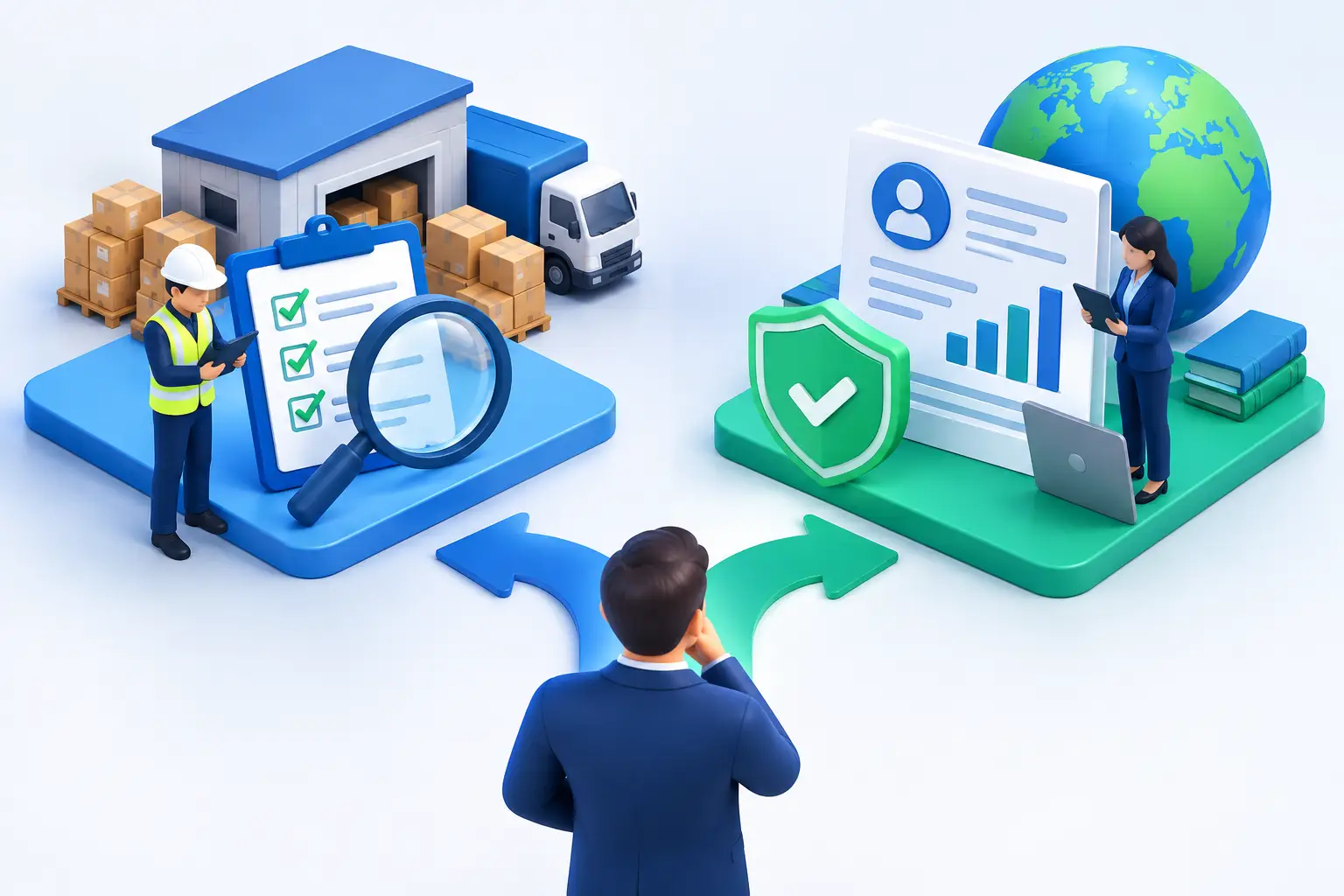
A supplier offers favorable pricing, a quick production schedule, and polished documents. The pressure to approve is real, particularly when a shipment, customer order, or tender deadline is waiting. But supplier audit vs due diligence is not a choice between two versions of the same check. They answer different commercial questions, at different points in the relationship.
Due diligence asks whether the business is a credible, legally identifiable, and acceptable counterparty before you commit money, contracts, credit, or strategic access. A supplier audit examines whether an operating supplier can consistently meet defined requirements, such as quality, capacity, labor practices, security, or process controls. Treating one as a substitute for the other can leave a serious gap.
For Hong Kong traders, procurement teams, and import-export businesses, the right sequence usually starts with due diligence. There is little value in auditing a factory’s production process if the company behind the proposal is misrepresented, subject to relevant restrictions, or unable to enter the contract it is offering.
Supplier Audit vs Due Diligence: The Core Difference
Supplier due diligence is counterparty risk assessment. Its purpose is to verify who you are dealing with and identify risks that could make the relationship unsafe, noncompliant, or commercially unsound. The review commonly considers legal identity, registration status, corporate ownership, directors, adverse public records, regulatory concerns, sanctions-related exposure where relevant, litigation indicators, and signs of fraud or financial distress.
A supplier audit is an operational assessment. It evaluates the supplier’s ability to perform. Depending on the scope, it may assess factory conditions, production capacity, quality-management systems, traceability, environmental practices, worker welfare, data security, inventory controls, and business continuity arrangements.
The distinction matters because a supplier can pass one review and fail the other. A properly registered company with a real factory may still have weak quality controls or insufficient capacity for your order. Conversely, a facility may appear organized and capable, while the entity seeking payment has unclear ownership, inconsistent registration details, or no confirmed authority to represent that facility.
Due diligence protects the decision to engage. An audit protects the decision to rely on the supplier’s operations.
What Due Diligence Should Establish Before Engagement
Before issuing a purchase order, paying a deposit, sharing designs, or extending credit, your team needs evidence that the supplier is the business it claims to be. A basic web search, a referral, or a video call cannot establish this reliably. Fraudulent counterparties can use copied company profiles, borrowed factory images, altered certificates, and email domains designed to resemble legitimate firms.
A practical due diligence review should first confirm the entity’s legal name, registration number, jurisdiction, status, and registered details. It should then compare that information with the supplier’s invoice, bank account details, website, contract party, and communications. Small inconsistencies are not always proof of wrongdoing, but they require explanation before funds move.
Ownership and control are equally relevant. You need to know whether the people negotiating the deal are connected to the legal entity, whether ownership creates compliance or reputation concerns, and whether any disclosed directors or beneficial owners appear in relevant public records. For higher-value relationships, this review should also consider market reputation, legal disputes, regulatory notices, and fraud indicators.
The output should not be a pile of database screenshots. Decision-makers need a clear view of what was verified, what could not be verified through legally accessible sources, and what actions should follow. That could mean proceeding, proceeding with conditions, requesting more documents, changing payment terms, or declining the relationship.
What a Supplier Audit Examines
Once the counterparty has passed initial screening, a supplier audit tests the operating reality behind the proposal. The precise scope depends on what you buy and what failure would cost.
For a manufacturer, the audit may focus on production lines, equipment, staffing, capacity planning, defect controls, inspection procedures, raw-material traceability, and contingency plans. For a logistics provider, the questions may center on warehouse controls, cargo security, insurance, subcontractor management, temperature handling, and incident response. A software or professional-services vendor may require a review of access controls, data handling, service continuity, and contractual performance measures rather than a site inspection.
An audit is strongest when it is tied to measurable requirements. “Factory appears satisfactory” is weak assurance. Evidence is more useful when it addresses whether the supplier can produce 20,000 units per month, maintain a stated defect threshold, preserve batch traceability, or recover from a port closure or power interruption.
Audits also have limitations. They are often site-specific and time-specific. A factory visit can show conditions on the day of inspection, but it cannot by itself verify corporate ownership, legal standing, payment-account legitimacy, or the background of a newly introduced intermediary. That is why an audit should not replace due diligence.
When You Need Due Diligence, an Audit, or Both
Not every purchase requires the same level of review. The right approach depends on transaction value, product criticality, country exposure, payment structure, regulatory sensitivity, and the cost of disruption.
Due diligence is the minimum safeguard when engaging an unfamiliar supplier, distributor, agent, investor, or partner. It is particularly urgent when the counterparty requests a large advance payment, proposes to use a personal or third-party bank account, changes company details late in negotiations, or offers pricing that is materially below the market. It is also appropriate before appointing exclusive distributors, entering joint ventures, sharing proprietary designs, or signing long-term supply agreements.
A supplier audit becomes more necessary when the supplier’s operational failure could stop your business or create legal exposure. This includes regulated goods, food, medical products, high-value components, customer-branded products, sensitive data, and suppliers that represent a large share of your available capacity.
Use both when the relationship is strategically significant. For example, an importer placing a large first order with a new overseas manufacturer should verify the contracting entity and payment recipient before paying a deposit. It should then assess whether the factory has the controls and capacity to deliver goods that meet specifications. Skipping either step creates a different, avoidable risk.
A Practical Sequencing Model for Procurement Teams
The most efficient process is not to apply the most intensive review to every vendor. It is to match the review to the risk, while making sure basic identity checks happen early enough to prevent loss.
Start with an intake process that captures the supplier’s legal name, registration number, operating address, key contacts, beneficial ownership information where available, product or service scope, expected annual spend, payment terms, and country of operation. Require the proposed contract party and beneficiary bank account to be identified before approval.
Next, conduct due diligence proportionate to the relationship. A low-value, noncritical vendor may need confirmation of identity and registration plus focused risk screening. A supplier receiving a substantial deposit or handling regulated goods requires deeper ownership, compliance, public-record, and market-risk assessment. Do not ignore unresolved discrepancies simply because a commercial team needs a fast answer.
Then decide whether an operational audit is required. Set audit criteria before the review begins, and connect findings to a corrective-action plan. If the supplier fails a requirement, specify whether it must remedy the issue before onboarding, whether its order volume should be limited, or whether the relationship should be rejected.
Finally, keep monitoring. Company status, ownership, enforcement actions, supply capacity, and payment instructions can change after onboarding. Risk control is not a one-time document collection exercise. Re-check suppliers when contracts renew, order values increase, bank details change, adverse news appears, or performance deteriorates.
Common Mistakes That Create Exposure
The most expensive errors often happen when teams confuse familiarity with verification. A supplier may be known to an employee, recommended by a customer, or visible at a trade show. Those facts can support a decision, but they do not independently verify the legal entity, ownership, or account receiving funds.
Another mistake is allowing the commercial urgency of an order to dictate the scope of review. Urgency is often legitimate, but it can also be used to discourage questions. If a supplier resists ordinary verification, refuses to explain mismatched details, or pushes for payment before documents can be checked, treat that behavior as a risk signal rather than an inconvenience.
Teams also lose control when due diligence and audit findings are stored in separate email threads with no clear approval record. A defensible process records the evidence reviewed, the exceptions accepted, the person who approved them, and the controls placed around the relationship. This is valuable when a dispute, fraud allegation, quality failure, or compliance question arises later.
Make the Review Match the Decision
The goal is not to slow procurement or create unnecessary paperwork. It is to prevent a manageable vendor decision from becoming a lost deposit, missed shipment, customer claim, regulatory issue, or reputational problem.
SDDCheck helps businesses turn legally accessible company, ownership, regulatory, and public-record information into source-cited risk findings that procurement and management teams can use quickly. Where a supplier audit is also needed, those findings can help determine what to inspect, what questions to ask, and where contractual safeguards are warranted.
Before the next deposit is approved or contract is signed, ask two separate questions: Is this the right business to engage, and can it deliver what it promises? Clear evidence for both is a far better basis for commercial confidence than a persuasive sales call.